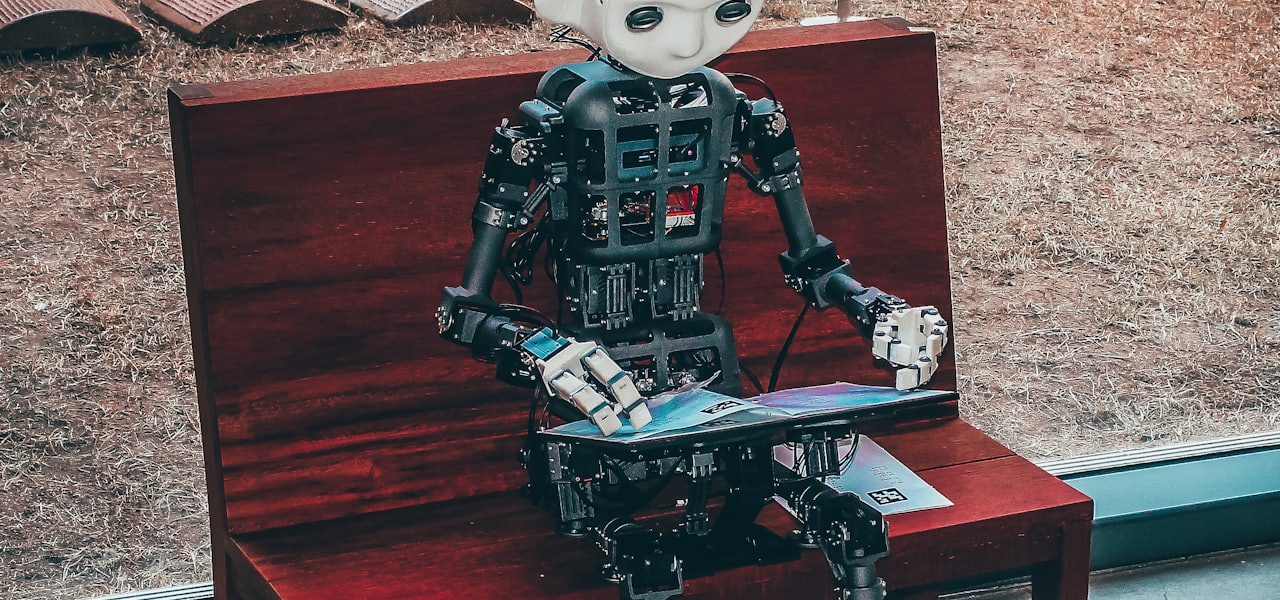
COTSBot is a small autonomous underwater vehicle (AUV) 4.5 feet (1.4 m) long, which is designed by Queensland University of Technology (QUT) to kill the very destructive crown-of-thorns starfish (Acanthaster planci) in the Great Barrier Reef off the north-east coast of Australia. It identifies its target using an image-analyzing neural net to analyze what an onboard camera sees, and then lethally injects the starfish with a bile salt solution using a needle on the end of a long underslung foldable arm. COTSBot uses GPS to navigate. The first version was created in the early 2000s with an accuracy rate of about 65%. After training COTSBot with machine learning, its accuracy rate rose to 99% by 2019. COTSBot is capable of killing 200 crown-of-thorns starfish with its two liters capacity of poison. COTSBot is capable of performing about 20 runs per day, but multiple COTSBots will be necessary to significantly impact the crown of thorns starfish populations. A smaller version of COTSBot called "RangerBot" is also being developed by QUT.
Clarizen
Clarizen, Inc. is a project management software and collaborative work management company. Clarizen uses a software as a service business model. Clarizen's features include attaching CAD drawings to a project, moving between the project view and design view and an E-mail reporting feature. In May 2014 Clarizen raised $35 million in venture capital investment led by Goldman Sachs. The round brought investment to $90 million. Previous investors, including Benchmark Capital, Carmel Ventures, DAG Ventures, Opus Capital and Vintage Investment Partners participated. In April 2020, Clarizen appointed Matt Zilli as its new CEO, replacing Boaz Chalamish who is appointed as Executive Chairman. In January 2021 Clarizen was acquired by Planview.
Shopify
Shopify Inc., stylized as shopify, is a Canadian multinational e-commerce company headquartered in Ottawa, Ontario that operates a platform for retail point-of-sale systems. The company has over 5 million customers and processed US$292.3 billion in transactions in 2024, of which 57% was in the United States. Major customers include Tesla, LVMH, Nestlé, PepsiCo, AB InBev, Kraft Heinz, Lindt, Whole Foods Market, Red Bull, and Hyatt. The company's software has been praised for its ease of use and reasonable fee structure. It has been described as the "go-to e-commerce platform for startups". However, the company has faced criticism for allegedly inflating their sales data and for associating with controversial sellers. == History == === 2006: Founding === Shopify was founded in 2006 by friends Tobias Lütke, Daniel Weinand and Scott Lake after launching Snowdevil, an online store for snowboarding equipment, in 2004. Dissatisfied with the existing e-commerce products on the market, Lütke, a computer programmer by trade, instead built his own. Lütke used the open source web application framework Ruby on Rails to build Snowdevil's online store and launched it after two months of development. The Snowdevil founders launched the platform as Shopify in June 2006. Shopify created an open-source template language called Liquid, which is written in Ruby and has been used since 2006. In June 2009, Shopify launched an application programming interface (API) platform and App Store. The API allows developers to create applications for Shopify online stores and then sell them on the Shopify App Store. === 2010s === In January 2010, Shopify started its Build-A-Business competition, in which participants create a business using its commerce platform. The winners of the competition received cash prizes and mentorship from entrepreneurs, such as Richard Branson, Eric Ries and others. In April of that year, Shopify launched a free mobile app on the Apple App Store. The app allows Shopify store owners to view and manage their stores from iOS mobile devices. In December 2010, Shopify raised $7 million from a series A round from Bessemer Venture Partners, FirstMark Capital, and Felicis Ventures at a $20 million pre-money valuation. At that time, the company had annualized transaction value of $132 million. In October 2011, it raised $15 million in a Series B round. In August 2013, Shopify launched Shopify Payments in partnership with Stripe. Shopify Payments allows merchants to accept payments without requiring a third-party payment gateway. The company also announced the launch of a point of sale system to enable in-person sales in addition to online. The company received $100 million in Series C funding in December 2013. Shopify earned $105 million in revenue in 2014, twice as much as it raised the previous year. In February 2014, Shopify released "Shopify Plus" for large e-commerce businesses seeking access to additional features and support. Shopify went public via an initial public offering on May 21, 2015 raising more than $131 million. In September 2015, Amazon.com closed its Amazon Webstore service for merchants and selected Shopify as the preferred migration provider; In April 2016, Shopify announced Shopify Capital, a cash advance product. Shopify Capital was initially piloted to merchants within the US and allowed merchants to receive an advance on future earnings processed through its payment gateway. Since its launch in 2016, Shopify Capital has provided more than $5.1 billion in funding to Shopify merchants, with a maximum advance of $2 million. On June 7, 2016, Shopify launched its Shopify Plus Partners Program, to help agencies connect with evolving businesses in ecommerce space. On October 3, 2016, Shopify acquired Boltmade. In November 2016, Shopify partnered with Paystack which allowed Nigerian online retailers to accept payments from customers around the world. On November 22, 2016, Shopify launched Frenzy, a mobile app that improves flash sales. In January 2017, Shopify announced integration with Amazon that would allow merchants to sell on Amazon from their Shopify stores. In April 2017, Shopify introduced its Chip & Swipe Reader, a Bluetooth enabled debit and credit card reader for brick and mortar retail purchases. The company has since released additional technology for brick and mortar retailers, including a point-of-sale system with a Dock and Retail Stand similar to that offered by Square, and a tappable chip card reader. Shopify announced a one-click accelerated checkout feature called Shopify Pay in April 2017 as an exclusive feature for merchants using Shopify Payments as their payment processor. Customers can save their shipping and payment information for future purchases from all participating Shopify stores. In November 2017 Shopify announced Arrive, a mobile application to help customers track packages from both Shopify merchants and other e-commerce websites. In September 2018, Shopify announced plans to expand its office space in Toronto's King West neighborhood in 2022 as part of "The Well" complex, jointly owned by Allied Properties REIT and RioCan REIT. In October 2018, Shopify opened its first flagship, a physical space for business owners in Los Angeles. The space offered educational classes, coworking space, a "genius bar" for companies that use Shopify software, and workshops. Online cannabis sales in Ontario, Canada, used Shopify's software when the drug was legalized in October 2018. Shopify's software is also used for in-person cannabis sales in Ontario since becoming legal in 2019. In January 2019, Shopify announced the launch of Shopify Studios, a full-service television and film content and production house. On March 22, 2019, Shopify and email marketing platform Mailchimp ended an integration agreement over disputes involving customer privacy and data collection. In April 2019, Shopify announced an integration with Snapchat to allow Shopify merchants to buy and manage Snapchat Story ads directly on the Shopify platform. The company had previously secured similar integration partnerships with Facebook and Google. On August 14, 2019, Shopify launched Shopify Chat, a new native chat function that allows merchants to have real-time conversations with customers visiting Shopify stores online. === 2020s === In January 2020, the company announced plans to hire in Vancouver, Canada. Additionally, the effects of the COVID-19 pandemic contributed to lifting stock prices. On February 21, 2020, Shopify announced plans to join the Diem Association, known as Libra Association at the time. Also that month, Shopify Pay was rebranded as Shop Pay. In April, Arrive was rebranded as Shop, combining both customer-facing features under a single brand. In May, during the COVID-19 pandemic, Shopify announced it would shift most of its global workforce to permanent remote work. It was reported that Shopify's valuation would likely rise on the back of options it had in the company Affirm that was expecting to go public shortly. In November 2020, Shopify announced a partnership with Alipay to support merchants with cross-border payments. Shopify also provided the opportunity for users to connect Alibaba and AliExpress to Shopify through a Alibaba Dropshipping app that could be purchased through the Shopify App Store. Multiple applications launched between 2021 and 2024 allowed customers to connect their Shopify store to their Alibaba account and then import and publish your products. The integration automatically syncs inventory and orders between both platforms so that Alibaba vendors can ship directly to dropshipping customers.As a result of Affirm's January 13, 2021 IPO, Shopify's 8% stake in Affirm was worth $2 billion. About half of Shopify's C-level executives left the company in early 2021. On June 29, 2021, Shopify removed the 20% revenue share for app developers that make less than US$1 million per year. On January 18, 2022, Shopify announced a partnership with JD.com to let U.S. merchants expand their operations in China, listing their products on JD's cross-border e-commerce platform JD Worldwide. On March 22, 2022, Shopify introduced Linkpop, a product to create a branded, social marketplace through which merchants can advertise and market their products via links to be added on social media channels. The following month, Shopify, Alphabet Inc., Meta Platforms, McKinsey & Company, and Stripe, Inc. announced a $925 million advance market commitment of carbon dioxide removal (CDR) from companies that are developing CDR technology over the next 9 years. In June 2022, Shopify partnered with Twitter. As a part of the deal, Twitter announced that it would launch a sales channel app for all of Shopify's U.S. merchants through its app store. Shopify also partnered with PayPal to offer Shopify Payments to merchants in France. On July 26, 2022, Lütke announced immediate layoffs totalling roughly 10 percent of its workforce. In
Co-occurrence matrix
A co-occurrence matrix or co-occurrence distribution (also referred to as : gray-level co-occurrence matrices GLCMs) is a matrix that is defined over an image to be the distribution of co-occurring pixel values (grayscale values, or colors) at a given offset. It is used as an approach to texture analysis with various applications especially in medical image analysis. == Method == Given a grey-level image I {\displaystyle I} , co-occurrence matrix computes how often pairs of pixels with a specific value and offset occur in the image. The offset, ( Δ x , Δ y ) {\displaystyle (\Delta x,\Delta y)} , is a position operator that can be applied to any pixel in the image (ignoring edge effects): for instance, ( 1 , 2 ) {\displaystyle (1,2)} could indicate "one down, two right". An image with p {\displaystyle p} different pixel values will produce a p × p {\displaystyle p\times p} co-occurrence matrix, for the given offset. The ( i , j ) th {\displaystyle (i,j)^{\text{th}}} value of the co-occurrence matrix gives the number of times in the image that the i th {\displaystyle i^{\text{th}}} and j th {\displaystyle j^{\text{th}}} pixel values occur in the relation given by the offset. For an image with p {\displaystyle p} different pixel values, the p × p {\displaystyle p\times p} co-occurrence matrix C is defined over an n × m {\displaystyle n\times m} image I {\displaystyle I} , parameterized by an offset ( Δ x , Δ y ) {\displaystyle (\Delta x,\Delta y)} , as: C Δ x , Δ y ( i , j ) = ∑ x = 1 n ∑ y = 1 m { 1 , if I ( x , y ) = i and I ( x + Δ x , y + Δ y ) = j 0 , otherwise {\displaystyle C_{\Delta x,\Delta y}(i,j)=\sum _{x=1}^{n}\sum _{y=1}^{m}{\begin{cases}1,&{\text{if }}I(x,y)=i{\text{ and }}I(x+\Delta x,y+\Delta y)=j\\0,&{\text{otherwise}}\end{cases}}} where: i {\displaystyle i} and j {\displaystyle j} are the pixel values; x {\displaystyle x} and y {\displaystyle y} are the spatial positions in the image I; the offsets ( Δ x , Δ y ) {\displaystyle (\Delta x,\Delta y)} define the spatial relation for which this matrix is calculated; and I ( x , y ) {\displaystyle I(x,y)} indicates the pixel value at pixel ( x , y ) {\displaystyle (x,y)} . The 'value' of the image originally referred to the grayscale value of the specified pixel, but could be anything, from a binary on/off value to 32-bit color and beyond. (Note that 32-bit color will yield a 232 × 232 co-occurrence matrix!) Co-occurrence matrices can also be parameterized in terms of a distance, d {\displaystyle d} , and an angle, θ {\displaystyle \theta } , instead of an offset ( Δ x , Δ y ) {\displaystyle (\Delta x,\Delta y)} . Any matrix or pair of matrices can be used to generate a co-occurrence matrix, though their most common application has been in measuring texture in images, so the typical definition, as above, assumes that the matrix is an image. It is also possible to define the matrix across two different images. Such a matrix can then be used for color mapping. == Aliases == Co-occurrence matrices are also referred to as: GLCMs (gray-level co-occurrence matrices) GLCHs (gray-level co-occurrence histograms) spatial dependence matrices == Application to image analysis == Whether considering the intensity or grayscale values of the image or various dimensions of color, the co-occurrence matrix can measure the texture of the image. Because co-occurrence matrices are typically large and sparse, various metrics of the matrix are often taken to get a more useful set of features. Features generated using this technique are usually called Haralick features, after Robert Haralick. Texture analysis is often concerned with detecting aspects of an image that are rotationally invariant. To approximate this, the co-occurrence matrices corresponding to the same relation, but rotated at various regular angles (e.g. 0, 45, 90, and 135 degrees), are often calculated and summed. Texture measures like the co-occurrence matrix, wavelet transforms, and model fitting have found application in medical image analysis in particular. == Other applications == Co-occurrence matrices are also used for words processing in natural language processing (NLP).
Switch (app)
Switch was a mobile-only job-matching app that connected candidates directly to hiring managers. Candidates could upload their resumes and connect their social and professional media profiles, but remain anonymous while searching. Users received a daily set of job recommendations that fit their backgrounds and salary criteria, and swipe right to apply. Employers post many jobs on Switch directly, which eliminates the need for third-party job boards and recruiters, and connects job seekers to hiring managers. Switch reveals a candidate’s identity to one employer at a time, only after the candidate matches with that employer. When candidates and employers match, they can chat within the app. Switch is available for iOS, with an Android version in development. == History == === Founding === Yarden Tadmor founded Switch in New York City in January 2014. For the first 10 months, Tadmor funded the company himself. By December 2014, Switch had raised $1.4 million in funding from venture capitals firms Metamorphic Ventures, SG VC, BAM and Rhodium. Tadmor's inspiration for Switch came after being frustrated by his experience both as a job seeker, and also as a supervisor hiring at numerous technology startup companies. Tadmor has said of Switch, “We operate on the five-second resume principle, which is usually the amount of time a recruiter spends on a resume. They scan through the typical data points and move on.” Switch was designed for passive job seekers to browse openings discreetly and connect quickly. Originally, Switch served only the New York metro area technology sector while in early beta, but Tadmor always intended to expand into national coverage. Soon, the company started including all major metropolitan markets across the U.S. In May 2015, Switch announced it would start sourcing tech and media jobs from all the job boards available online. Later in 2015, Switch began to post jobs in smaller urban areas. The company also expanded industries and jobs to include restaurant staff, retail sales, healthcare, nursing and education. Tadmor subsequently founded Livekick, a one-on-one private fitness and yoga instruction company, based in New York. == Operation == In May 2015, Switch reported generating over 400,000 job applications. The company said that nine of the 50 largest websites in the U.S. were using the service. It had grown its customer base to thousands of companies in a few months from launch including Microsoft, Amazon, Facebook, IBM, Yahoo!, eBay, DropBox, SoundCloud, and Wikipedia. John Cline, software development manager at eBay, told ABC’s Good Morning America that Switch is now his “main way of finding new prospective employees.” Switch uses a double opt-in technique, meaning job seekers and employers must both say yes before moving forward. They also use swiping technology and intelligent matching algorithms to connect job seekers and employers. The user experience is different for each group, but the major attraction for both sides is the speed at which they can be connected. === Features === Swipe is a major aspect of the Switch user experience. Job seekers swipe to apply to jobs, or left to pass on positions. Employers respond and swipe right to reciprocate interest, or left to eliminate the candidate. Direct connection between job seekers and employers allows hiring managers and job seekers to start an immediate conversation. Hiring managers can message with job seekers within the app, and both parties can quickly vet one another and decide whether to move forward. Easy profile creation from social media and in-app profile editing helps job seekers focus on finding a job. === Users === Job Seekers can either load their profile manually or pull in professional credentials from social media. They can post validated photos on their Facebook account. Switch’s matching algorithm analyzes the job seeker’s location, experience, and skills to bring them jobs they may be interested in. Job seekers swipe to apply and, if the employer shows interest too, only then does Switch’s system reveal the job seeker’s identity to the corporate recruiter or hiring manager. The job seeker and hiring manager can then chat through the app. Employers behave similarly to job seekers. Hiring managers or corporate recruiters sign up online, add open positions, then view Switch-recommended candidates or wait for job seekers to swipe right. Employers can select relevant job seekers by swiping right on their profiles, then chat directly in the app. === Subscriptions === The app is currently free for users and employers. == Company overview == === Financials === Switch closed out its seed round in May 2015 with $2 million in seed round funding. Investors include Marker VC, Metamorphic, Rhodium, 500 Startups, BAM, SG VC and Marcel Legrand. In a July 2015 interview with Tadmor, he claimed that Switch had raised $2.4 million to date. == Reception == Thanks to its swipe technology and double opt-in make-up, the media often refers to Switch as the Tinder for jobs. Switch has received features in lists and app reviews as an effective tool to improve your digital job search, particularly on the mobile platform. “It’s minimal effort to connect with relevant matches,” said Good Morning America workplace contributor Tory Johnson. “Which is what everybody wants to find.”
AltStore
AltStore is an alternative app store for the iOS and iPadOS[1] mobile operating systems, which allows users to download applications that are not available on the App Store, most commonly tweaked apps, jailbreak apps, and apps including paid apps on the app store. It was publicly announced on September 25, 2019, and launched on September 28. == History == Riley Testut is an American developer who began to work on AltStore after Apple declined to allow his Nintendo emulator Delta on the App Store. Since Xcode allowed him to temporarily install his Delta app to his iOS device for 7 days of testing, he created AltStore in 2019 to replicate this functionality, which could be extended to other .ipa files. As of 2022, AltStore had been downloaded 1.5 million times. In the following years, AltStore expanded beyond its initial sideloading functionality. The platform was founded by Testut, with Shane Gill later joining as co-founder. AltStore was initially supported through Patreon contributions from its user community, and later saw increased adoption following regulatory developments in the European Union that enabled broader third-party app distribution. The project has also been involved in notable industry collaborations, including a partnership with Epic Games. == Features == AltStore exploits a loophole in the Xcode developer platform, which allows developers to sideload their own apps which they are working on without needing to jailbreak. Sideloaded apps are signed like a developer project for testing and will expire after 7 days with a free account or one year with a paid developer account, by which they will need to be refreshed or reinstalled.
Curve (tonality)
In image editing, a curve is a remapping of image tonality, specified as a function from input level to output level, used as a way to emphasize colours or other elements in a picture. Curves can usually be applied to all channels together in an image, or to each channel individually. Applying a curve to all channels typically changes the brightness in part of the spectrum. Light parts of a picture can be easily made lighter and dark parts darker to increase contrast. Applying a curve to individual channels can be used to stress a colour. This is particularly efficient in the Lab colour space due to the separation of luminance and chromaticity, but it can also be used in RGB, CMYK or whatever other colour models the software supports.