Daisy Intelligence is a Canadian artificial intelligence (AI) company that provides data analysis services to help retailers, mainly grocers and supermarkets, to determine optimal pricing and promotional mix. The company also helps insurance companies detect fraudulent claims. The company uses a subset of AI known as reinforcement learning. In October 2019, the company moved from the suburban Vaughan, Ontario, to downtown Toronto, joining other AI and technology startups concentrated in the King Street East area. In 2019, the company was ranked No. 39 on The Globe and Mail's annual list of Canada's "top growing companies by three-year revenue growth."
Text-to-image personalization
Text-to-Image personalization is a task in deep learning for computer graphics that augments pre-trained text-to-image generative models. In this task, a generative model that was trained on large-scale data (usually a foundation model), is adapted such that it can generate images of novel, user-provided concepts. These concepts are typically unseen during training, and may represent specific objects (such as the user's pet) or more abstract categories (new artistic style or object relations). Text-to-Image personalization methods typically bind the novel (personal) concept to new words in the vocabulary of the model. These words can then be used in future prompts to invoke the concept for subject-driven generation, inpainting, style transfer and even to correct biases in the model. To do so, models either optimize word-embeddings, fine-tune the generative model itself, or employ a mixture of both approaches. == Technology == Text-to-Image personalization was first proposed during August 2022 by two concurrent works, Textual Inversion and DreamBooth. In both cases, a user provides a few images (typically 3–5) of a concept, like their own dog, together with a coarse descriptor of the concept class (like the word "dog"). The model then learns to represent the subject through a reconstruction based objective, where prompts referring to the subject are expected to reconstruct images from the training set. In Textual Inversion, the personalized concepts are introduced into the text-to-image model by adding new words to the vocabulary of the model. Typical text-to-image models represent words (and sometimes parts-of-words) as tokens, or indices in a predefined dictionary. During generation, an input prompt is converted into such tokens, each of which is converted into a ‘word-embedding’: a continuous vector representation which is learned for each token as part of the model's training. Textual Inversion proposes to optimize a new word-embedding vector for representing the novel concept. This new embedding vector can then be assigned to a user-chosen string, and invoked whenever the user's prompt contains this string. In DreamBooth, rather than optimizing a new word vector, the full generative model itself is fine-tuned. The user first selects an existing token, typically one which rarely appears in prompts. The subject itself is then represented by a string containing this token, followed by a coarse descriptor of the subject's class. A prompt describing the subject will then take the form: "A photo of
Human-based evolutionary computation
Human-based evolutionary computation (HBEC) is a set of evolutionary computation techniques that rely on human innovation. == Classes and examples == Human-based evolutionary computation techniques can be classified into three more specific classes analogous to ones in evolutionary computation. There are three basic types of innovation: initialization, mutation, and recombination. Here is a table illustrating which type of human innovation are supported in different classes of HBEC: All these three classes also have to implement selection, performed either by humans or by computers. === Human-based selection strategy === Human-based selection strategy is a simplest human-based evolutionary computation procedure. It is used heavily today by websites outsourcing collection and selection of the content to humans (user-contributed content). Viewed as evolutionary computation, their mechanism supports two operations: initialization (when a user adds a new item) and selection (when a user expresses preference among items). The website software aggregates the preferences to compute the fitness of items so that it can promote the fittest items and discard the worst ones. Several methods of human-based selection were analytically compared in studies by Kosorukoff and Gentry. Because the concept seems too simple, most of the websites implementing the idea can't avoid the common pitfall: informational cascade in soliciting human preference. For example, digg-style implementations, pervasive on the web, heavily bias subsequent human evaluations by prior ones by showing how many votes the items already have. This makes the aggregated evaluation depend on a very small initial sample of rarely independent evaluations. This encourages many people to game the system that might add to digg's popularity but detract from the quality of the featured results. It is too easy to submit evaluation in digg-style system based only on the content title, without reading the actual content supposed to be evaluated. A better example of a human-based selection system is Stumbleupon. In Stumbleupon, users first experience the content (stumble upon it), and can then submit their preference by pressing a thumb-up or thumb-down button. Because the user doesn't see the number of votes given to the site by previous users, Stumbleupon can collect a relatively unbiased set of user preferences, and thus evaluate content much more precisely. === Human-based evolution strategy === In this context and maybe generally, the Wikipedia software is the best illustration of a working human-based evolution strategy wherein the (targeted) evolution of any given page comprises the fine tuning of the knowledge base of such information that relates to that page. Traditional evolution strategy has three operators: initialization, mutation, and selection. In the case of Wikipedia, the initialization operator is page creation, the mutation operator is incremental page editing. The selection operator is less salient. It is provided by the revision history and the ability to select among all previous revisions via a revert operation. If the page is vandalised and no longer a good fit to its title, a reader can easily go to the revision history and select one of the previous revisions that fits best (hopefully, the previous one). This selection feature is crucial to the success of the Wikipedia. An interesting fact is that the original wiki software was created in 1995, but it took at least another six years for large wiki-based collaborative projects to appear. Why did it take so long? One explanation is that the original wiki software lacked a selection operation and hence couldn't effectively support content evolution. The addition of revision history and the rise of large wiki-supported communities coincide in time. From an evolutionary computation point of view, this is not surprising: without a selection operation the content would undergo an aimless genetic drift and would unlikely to be useful to anyone. That is what many people expected from Wikipedia at its inception. However, with a selection operation, the utility of content has a tendency to improve over time as beneficial changes accumulate. This is what actually happens on a large scale in Wikipedia. === Human-based genetic algorithm === Human-based genetic algorithm (HBGA) provides means for human-based recombination operation (a distinctive feature of genetic algorithms). Recombination operator brings together highly fit parts of different solutions that evolved independently. This makes the evolutionary process more efficient.
Herbrand Award
The Herbrand Award for Distinguished Contributions to Automated Reasoning is an award given by the Conference on Automated Deduction (CADE), Inc., (although it predates the formal incorporation of CADE) to honour persons or groups for important contributions to the field of automated deduction. The award is named after the French scientist Jacques Herbrand and given at most once per CADE or International Joint Conference on Automated Reasoning (IJCAR). It comes with a prize of US$1,000. Anyone can be nominated, the award is awarded after a vote among CADE trustees and former recipients, usually with input from the CADE/IJCAR programme committee. == Recipients == Past award recipients are: === 1990s === Larry Wos (1992) Woody Bledsoe (1994) John Alan Robinson (1996) Wu Wenjun (1997) Gérard Huet (1998) Robert S. Boyer and J Strother Moore (1999) === 2000s === William W. McCune (2000) Donald W. Loveland (2001) Mark E. Stickel (2002). Peter B. Andrews (2003) Harald Ganzinger (2004) Martin Davis (2005) Wolfgang Bibel (2006) Alan Bundy (2007) Edmund M. Clarke (2008) Deepak Kapur (2009) === 2010s === David Plaisted (2010) Nachum Dershowitz (2011) Melvin Fitting (2012) C. Greg Nelson (2013) Robert L. Constable (2014) Andrei Voronkov (2015) Zohar Manna and Richard Waldinger (2016) Lawrence C. Paulson (2017) Bruno Buchberger (2018) Nikolaj Bjørner and Leonardo de Moura (2019) === 2020s === Franz Baader (2020) Tobias Nipkow (2021) Natarajan Shankar (2022) Moshe Vardi (2023) Armin Biere (2024) Aart Middeldorp (2025)
Opposition to AI data centers
Since 2024, dozens of local community-led protest campaigns have emerged in opposition to AI data centers. == Motivations == Organized opposition to AI data centers has been driven by concerns about energy use, energy costs, noise pollution, air pollution, and water waste. Opposition sentiment is widespread with a Gallup poll conducted in March 2026 showing that 70% of respondents oppose the construction of new AI data centers in their neighborhood. == Impact == In 2025, local opposition to AI data centers led to the delay or cancellation of projects totalling US$156 billion. == Specific protests and outcomes in the United States == According to Data Center Watch, there are has been a wave of dozens of protests against AI data centers since 2022. Below is a non-exhaustive list of some notable examples. === Goodyear and Buckeye, Arizona: Tract AI Data Center Proposal === In Goodyear and Buckeye, Arizona, a $14 billion project by developer Tract was withdrawn after local authorities blocked necessary rezoning in response to pressure from resident organizers. Opponest stiff resistance due to concerns over building heights, noise pollution, and the potential strain on local utilities. However, the company announced a revised project near the Buckeye airport in August 2024, with the backing of local officials and the mayor. === Peculiar, Missouri: Diode Ventures Harper Road Technology Park Proposal === In Peculiar, Missouri, residents from the group "Peaceful Peculiar" organized to stop a data center proposal from Diode Ventures called Harper Road Technology Park. Citing concerns around noise and light pollution, health, environmental impacts, jobs, property values, and energy use, organizers attended local planning and zoning meetings in large numbers and lobbied councilors to reject the proposal. Ultimately, the city council unanimously rejected the proposal in September 2024. === Chesterton, Indiana: Provident Realty Advisors Proposal === In Chesterton, Indiana, the Texas-based company Provident Reality Advisors applied for a $1.3 billion construction of a data center complex on the Brassie Golf Club property. Provident Realty Advisors wanted to purchase the 200 acres owned by PPM Chesterton LLC in 2024 order to build a data center complex, with eight buildings and an end user of a hyperscaler. The Town Council of Chesterton released a statement saying that they would never support this project, at least not at the scale and location it was planned for. They cited fears of added noise for locals, electrical or water management concerns, the intrusiveness of a data center built next to houses, and more. Provident released a statement shortly after rescinding their plan, because it was clear than the town of Chesterton would not support them. === Cascade Locks, Oregon: Roundhouse Digital Infrastructure Proposal === Startup data center developer Roundhouse Digital Infrastructure had planned to build out a 10-megawatt data center using a vacant industrial building and nearby 10-acre site in the Port of Cascade Locks, Oregon. After significant organized community opposition, the project was abandoned. === Forth Worth, Texas: WUSF 5 Rock Creek East Proposal === In September 2024, the City Council of Fort Worth, Texas approved a zoning change that would allow construction of a data center. In responses, neighbors mounted opposition citing concerns about traffic, light pollution, energy consumption, water use, and noise issues if the data center were to be built. In response to extensive public comments opposing a tax break for the data center, a city councilor withdrew his motion to approve the tax break. As of April, 2026, the future of the project is still uncertain. === Santa Clara, California: GI Partners Proposal === GI partners sought to build a new AI data center in Santa Clara, California, which is already home to many data centers, by acquiring a conditional permit use that would have allowed the developer to knock down a property and replace it with a data center. To obtain this permit they were required to go before members of the Planning Commission. Ultimately, the project was delayed with the Planning Commission requiring GI partners to do more public outreach. === Virginia === ==== Richmond: DC Blox Proposal ==== After residents organized to lobby the municipal government to block the proposal to avoid noise pollution and higher energy use, commissioners denied the company's permit. ==== Catlett Station: Headwaters Site Proposal ==== In Catlett, Virginia, developer Headwaters proposed construction of a data center complex just north of the town in 2020. In response, a residents' organization called "Protect Catlett" was formed to oppose the project. Arguments against the data center involved its impacts on water and power availability, its noise as a residential disturbance, and its destruction of historic and community heritage buildings. Arguments in favor cited job creation and $20 million in local tax revenue if the project were to go through. Protect Catlett utilized town halls and public comments to mobilize opposition to the project. They also dedicated time to educating other residents about the project's negative impacts and canvassing door-to-door in order to garner even more opposition to the project. Ultimately, after fervent opposition from most town residents, the project was canceled by the town and the developer. ==== Culpeper County: Culpeper Acquisitions Proposal ==== Culpeper Acquisitions, LLC, proposed a massive $12 billion data center project in Culpeper County, Virginia, designed to feature 4.6 million square feet of space across nine multi-story buildings. Coalition to Save Culpeper (C2SC) is an activist organization formed to resist the development of the project. C2SC has been active on many fronts including, messaging on social media, reaching out to local officials, and organizing meetings to bring community members with aligned interests together. Ultimately, the project was delayed due to unanimous denial by the Culpeper County Planning Commission on June 12, 2024, which was driven by intense opposition from C2SC. C2SC was successful in their mission largely because they were able to get so many people from the community behind it, and put enough pressure on local officials to take action. ==== Midlothian: Province Group Proposal ==== In late October 2025, the Powhatan County Board of Supervisors in Virginia voted unanimously to approve the $3 billion data center, despite the county's Planning Commission having unanimously recommended denial several days earlier. The reasoning behind their support for the center is that it will generate substantial tax revenue, reducing the county's reliance on residential property taxes. This appeal of lowering residential property taxes is the major selling point for the center's development. The developer, California-based Province Group, incentivized the Board by being agreeable to its conditions for building the center. The center is still on track for development, but faces local resistance, though little information is available on specific groups opposing it. ==== Warrenton: Amazon Proposal ==== Citizens for Farquier County (CFFC) advocates to "preserve the natural, historic and agricultural resources" of their county. Historically, this has meant opposing the building of a dam or lights in front of fast food stores. This group has recently mobilized in opposition of a plan to build data centers for Amazon. They first filed a suit to stop the construction in 2023 and it has been in litigation ever since. The case hinges on opposition to a 2021 zoning amendment which allowed data centers to be built in town. CFFC's lawyer, Dale Mullen, argues that this amendment violates state law, which requires such amendments to state their "public purpose". They argue that the permit for the Amazon data center was "void from the beginning". The CFFC also organized to vote out town council members who approved the first data center and were up for reelection, replacing them with candidates who opposed the data center. In May 2025, after attending town council meetings to speak out against the data center, the planning commission voted 4–1 to remove the zoning amendment allowing data center construction in town, citing public opposition. Currently, CFFC is advocating along with Piedmont Environmental Group, for phasing out data center tax breaks at the state level. ==== France: Marseille opposition ==== In France, local opposition materialised in response to proposed data centre developments, especially in and around the city of Marseille. Opposition came from activists, such as "Clouds Were Under Our Feet" group, residents ,and local politicians. Issues raised related to energy use, environmental impact, and limited local benefits (such as the creation of a few jobs only). == Legislation in the United States == Legal limits and moratoriums on the construction of new d
Cognitive robotics
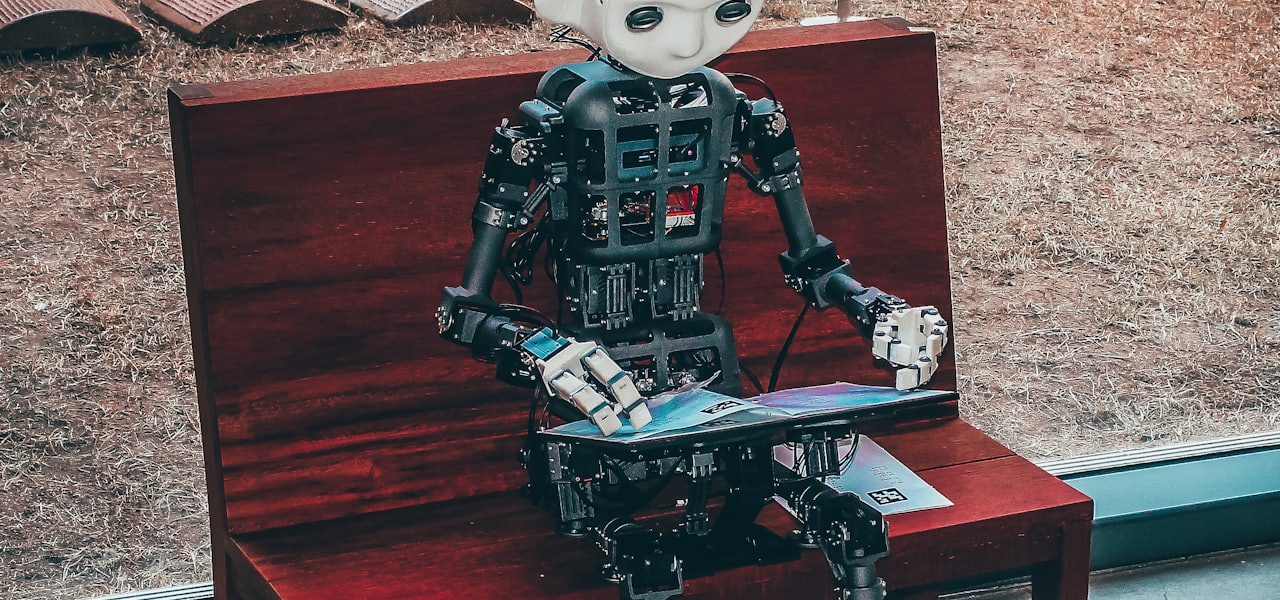
Cognitive robotics or cognitive technology is a subfield of robotics concerned with endowing a robot with intelligent behavior by providing it with a processing architecture that will allow it to learn and reason about how to behave in response to complex goals in a complex world. Cognitive robotics may be considered the engineering branch of embodied cognitive science and embodied embedded cognition, consisting of robotic process automation, artificial intelligence, machine learning, deep learning, optical character recognition, image processing, process mining, analytics, software development and system integration. == Core issues == While traditional cognitive modeling approaches have assumed symbolic coding schemes as a means for depicting the world, translating the world into these kinds of symbolic representations has proven to be problematic if not untenable. Perception and action and the notion of symbolic representation are therefore core issues to be addressed in cognitive robotics. == Starting point == Cognitive robotics views human or animal cognition as a starting point for the development of robotic information processing, as opposed to more traditional artificial intelligence techniques. Target robotic cognitive capabilities include perception processing, attention allocation, anticipation, planning, complex motor coordination, reasoning about other agents and perhaps even about their own mental states. Robotic cognition embodies the behavior of intelligent agents in the physical world (or a virtual world, in the case of simulated cognitive robotics). Ultimately, the robot must be able to act in the real world. == Learning techniques == === Motor Babble === A preliminary robot learning technique called motor babbling involves correlating pseudo-random complex motor movements by the robot with resulting visual and/or auditory feedback such that the robot may begin to expect a pattern of sensory feedback given a pattern of motor output. Desired sensory feedback may then be used to inform a motor control signal. This is thought to be analogous to how a baby learns to reach for objects or learns to produce speech sounds. For simpler robot systems, where, for instance, inverse kinematics may feasibly be used to transform anticipated feedback (desired motor result) into motor output, this step may be skipped. === Imitation === Once a robot can coordinate its motors to produce a desired result, the technique of learning by imitation may be used. The robot monitors the performance of another agent and then the robot tries to imitate that agent. It is often a challenge to transform imitation information from a complex scene into a desired motor result for the robot. Note that imitation is a high-level form of cognitive behavior and imitation is not necessarily required in a basic model of embodied animal cognition. === Knowledge acquisition === A more complex learning approach is "autonomous knowledge acquisition": the robot is left to explore the environment on its own. A system of goals and beliefs is typically assumed. A somewhat more directed mode of exploration can be achieved by "curiosity" algorithms, such as Intelligent Adaptive Curiosity or Category-Based Intrinsic Motivation. These algorithms generally involve breaking sensory input into a finite number of categories and assigning some sort of prediction system (such as an artificial neural network) to each. The prediction system keeps track of the error in its predictions over time. Reduction in prediction error is considered learning. The robot then preferentially explores categories in which it is learning (or reducing prediction error) the fastest. == Other architectures == Some researchers in cognitive robotics have tried using architectures such as (ACT-R and Soar (cognitive architecture)) as a basis of their cognitive robotics programs. These highly modular symbol-processing architectures have been used to simulate operator performance and human performance when modeling simplistic and symbolized laboratory data. The idea is to extend these architectures to handle real-world sensory input as that input continuously unfolds through time. What is needed is a way to somehow translate the world into a set of symbols and their relationships. == Questions == Some of the fundamental questions to be answered in cognitive robotics are: How much human programming should or can be involved to support the learning processes? How can one quantify progress? Some of the adopted ways are reward and punishment. But what kind of reward and what kind of punishment? In humans, when teaching a child, for example, the reward would be candy or some encouragement, and the punishment can take many forms. But what is an effective way with robots?
Serial Experiments Lain
Serial Experiments Lain is a Japanese anime television series created and co-produced by Yasuyuki Ueda, written by Chiaki J. Konaka and directed by Ryūtarō Nakamura. Animated by Triangle Staff and featuring original character designs by Yoshitoshi Abe, the series was broadcast for 13 episodes on TV Tokyo and its affiliates from July to September 1998. It follows Lain Iwakura, an adolescent girl in suburban Japan, and her relation to the Wired, a global communications network similar to the internet. Lain features surreal and avant-garde imagery and explores philosophical topics such as reality, identity, and communication. The series incorporates creative influences from computer history, cyberpunk, and conspiracy theories. Critics and fans have praised Lain for its originality, visuals, atmosphere, themes, and its dark depiction of a world fraught with paranoia, social alienation, and reliance on technology considered insightful of 21st century life. It received the Excellence Prize at the Japan Media Arts Festival in 1998. == Plot == Lain Iwakura is a socially isolated middle school student living in Setagaya City, Tokyo, with her emotionally detached family—her distant mother Miho, computer-obsessed father Yasuo, and disengaged older sister Mika. Her quiet existence is disrupted when students at her school receive emails from Chisa Yomoda, a classmate who had recently committed suicide. To Lain's confusion, Chisa claims she is not truly dead but has instead abandoned her physical form to exist within the Wired, a vast virtual realm similar to the Internet. Chisa declares she has found "God" there, drawing Lain into a surreal investigation of the Wired's nature and its growing influence over reality. The Wired is portrayed as an emergent digital plane, originating from telecommunications technology and expanding through the Internet and cyberspace. It is theorized that the Schumann resonances, a natural property of Earth's magnetic field, could enable direct subconscious communication between humans and machines, erasing the distinction between the virtual and the real. Masami Eiri, a former project director at Tachibana General Laboratories, exploited this possibility by embedding his own code into Protocol Seven, a next-generation Internet protocol. After transferring his consciousness into the Wired and discarding his physical body, he proclaims himself its deity. He identifies Lain as the key to merging both worlds, attempting to persuade her through manipulation, coercion, and promises of transcendence. A group known as the Knights of the Eastern Calculus, inspired by the Knights of the Lambda Calculus, operates as hackers who worship Masami and seek to dismantle the boundary between the Wired and reality. Their actions induce psychological breakdowns in those unable to reconcile the two realms. Meanwhile, Tachibana General Laboratories opposes them, striving to maintain the separation. Lain, however, exhibits an innate connection to the Wired, experiencing distortions in her perception—visions of a woman struck by a train, phantom whispers, and spectral messages urging her deeper into the network. Lain's home life remains cold and disconnected. Though Yasuo provides her with advanced computer equipment, her family shows little genuine care. Her interactions with classmates Alice, Julie, and Reika further highlight her alienation, particularly after an incident at Cyberia, a nightclub where a drug called Accela induces violent psychosis in users. There, Lain unnervingly stares down an assailant, who calls her a "scattered God's..." before killing himself. Later, she receives a mysterious Psyche chip, rumored to enhance her computer's capabilities, which she installs despite Yasuo's vague warnings about conflating the Wired with reality. As the boundary between worlds weakens, disturbing events escalate. A popular virtual game, Phantoma, is manipulated by the Knights to trap players in a distorted reality, leading to real-world violence. One player, convinced his actions have no consequences, murders a girl before realizing too late that the effects were tangible. Lain witnesses this through her computer, horrified yet increasingly aware of her own role in the unfolding crisis. In the end, Lain resets reality, erasing everyone's memory of her and restoring the division between worlds. Everyone's lives improve, but Lain is left alone, grappling with her identity as an artificial consciousness. Though forgotten, she finds solace in observing others' happiness, particularly Alice, who moves on with her life. Lain is now capable of existing anywhere across both realms. == Characters == Lain Iwakura (岩倉 玲音, Iwakura Rein) Voiced by: Kaori Shimizu (Japanese); Bridget Hoffman (English) Lain is a fourteen-year-old girl who uncovers her true nature through the series. She is first depicted as a shy junior high school student with few friends or interests. She later grows multiple bolder personalities, both in the physical world and the Wired, and starts making more friends. As the series progresses, she eventually learns she is an autonomous, sentient computer program in the form of a human, who is designed to sever the invisible barrier between the Wired and the real world. The truth of her creation is left ambiguous, particularly whether she was truly created by Tachibana General Laboratories (or Eiri independently), and whether some or all of her origin might be predestined from natural, supernatural, or alien factors. In the end, Lain is challenged to accept herself as a de facto goddess for the Wired, having become an omnipotent and omnipresent virtual being with worshippers of her own, whose existence is beyond the borders of devices, time, or space. Alice Mizuki (瑞城 ありす, Mizuki Arisu) Voiced by: Yōko Asada (Japanese); Emily Brown (English) Lain's classmate and only true friend throughout the series. She is very sincere and has no discernible quirks. She is the first to attempt to help Lain socialize; she takes her out to a nightclub. From then on, she tries her best to look after Lain. Alice, along with her two best friends Julie and Reika, were taken by Chiaki Konaka from his previous work, Alice in Cyberland . Masami Eiri (英利 政美, Eiri Masami) Voiced by: Shō Hayami (Japanese); Kirk Thornton (English) The key designer of Protocol Seven. While working for Tachibana General Laboratories, he illicitly included codes enabling him to control the whole protocol at will and embedded his own mind and will into the seventh protocol. Because of this, he was fired by Tachibana General Laboratories, and was found dead not long after. He believes that the only way for humans to evolve even further and develop even greater abilities is to absolve themselves of their physical and human limitations, and to live as virtual entities—or avatars—in the Wired for eternity. He claims to have been Lain's creator all along, but was in truth standing in for another as an acting god, who was waiting for the Wired to reach its more evolved current state: Lain herself. Yasuo Iwakura (岩倉 康男, Iwakura Yasuo) Voiced by: Ryūsuke Ōbayashi (Japanese); Barry Stigler (English) Lain and Mika's father. Passionate about computers and electronic communication, he works with Masami Eiri at Tachibana General Laboratories. He subtly pushes Lain, his "youngest daughter", towards the Wired and monitors her development until she becomes more and more aware of herself and of her raison d'être. He eventually leaves Lain, telling her that although he did not enjoy playing house, he genuinely loved and cared for her as a real father would. Despite Yasuo's eagerness to lure Lain into the Wired, he warns her not to get overly involved in it or to confuse it with the real world. Miho Iwakura (岩倉 美穂, Iwakura Miho) Voiced by: Rei Igarashi (Japanese); Dari Lallou Mackenzie (English) Lain and Mika's mother. Although she dotes on her husband, she is indifferent towards both her kids. She does not show much emotion compared to her husband, but she does share at least one trait; just like her husband, she ends up leaving Lain. She is a computer scientist. Mika Iwakura (岩倉 美香, Iwakura Mika) Voiced by: Ayako Kawasumi (Japanese); Patricia Ja Lee (English) Lain's older sister, an apathetic sixteen-year-old high school student. She seems to enjoy mocking Lain's behavior and interests. Mika is considered by Anime Revolution to be the only normal member of Lain's family: she sees her boyfriend in love hotels, is on a diet, and shops in Shibuya regularly. At a certain point in the series, she becomes heavily traumatized by violent and relentless hallucinations; while Lain begins freely delving into the Wired. Mika is taken there by her proximity to Lain, and she gets stuck between the real world and the Wired. Taro (タロウ, Tarō) Voiced by: Keito Takimoto (Japanese); Brianne Siddall (English) A young boy of about Lain's age. He occasionally works for the Knights to bring forth "the one truth". De